Working Group on Seanad Reform
The Taoiseach has established a Working Group on Seanad Reform. The principal focus of the working group will be on possible reforms of the Seanad Electoral system within the existing constitutional parameters. The Working Group will also explore ways of reforming Seanad Éireann generally and the manner in which it carries out its business. The Group will examine these issues also within existing Constitutional parameters.
The Working Group will examine submissions and proposals for reform which have already been made and will also look at:
• the role of a reformed Seanad within the political process;
• the powers and functions of a reformed Seanad; and
• any such matter as the working party sees as relevant.
Members of the Working Group: The Group is chaired by
Dr. Maurice Manning (Chancellor of the National University of Ireland and former Senator)
Mary O'Rourke (former Minister and Senator)
Pat Magner (former Senator)
Dr. Maurice Hayes (former Senator, former Northern Ireland Ombudsman and former Chairman of the National Forum on Europe)
Joe O’Toole (former Senator)
Tom Arnold (former Chairman of the Constitutional Convention)
Dr. Mary C Murphy (lecturer in politics in UCC)
Dr. Elaine Byrne (commentator and author on public policy)
The Working Group on Seanad Reform held its first meeting 17th December 2014
Working Group on Seanad Reform - Consultation Process
Submissions received by the Working Group on Seanad Reform
Unfortunately the consultation was announced just before christmas so it was exteneded
Working Group on Seanad Reform Consultation Process - extension of closing date for submissions MerrionStreet
Working group on Seanad Reform
Submissions received by the Working Group on Seanad Reform
Working group on Seanad Reform Report
I dont think they mentioned having the election the same day as the dail election , the biggest disappointment in the taoiseach's seanad reform working group report
Draft Bill produced by the Working Group
As a first step, I intend on meeting with the opposition party leaders to discuss its contents. I have also requested the Working Group to make a presentation to the Oireachtas Committee on Environment, Culture and the Gaeltacht, and the Committee on Procedure and Privileges on the Seanad. I hope that the Chairperson and some members of the Working Group will also attend a hearing in the Seanad for further debate and analysis.
The Maurice Manning and Joe O'Toole two member of the working group discussed the report in the Seanad on the 5th of May 2015.
Has Kenny met the opposition on it?
Statement by the Taoiseach on the Report of the Working Group on Seanad Reform
Dail 31 Reform Timleine
Seanad Electoral Reform Bill 2013 John Crown 01/03/2013
Seanad Bill 2013 Senator Katherine Zappone; and Senator Feargal Quinn; and Senator Mary Ann O'Brien 09/05/2013
Seanad (No. 2) Bill 2013 [PMB] Deputy Stephen S. Donnelly and Deputy Noel Grealish and Deputy Finian McGrath and Deputy Mattie McGrath and Deputy Shane Ross 28/05/2013
Referendum Failed 04/10/2013
A Bill to Reform the Seanad Senator Katherine Zappone 07/10/2013
Seanad Reform: Statements 23/10/2013
Seanad Reform Bill 2014 Deputy Micheál Martin 09/05/2013
Seanad Reform: Motion Katherine Zappone 29/01/2014
Political Reform: Motion David Norris 12/02/2014
Seanad Reform 100 Days Since The People Decided Democracy-Matters 21/02/2014
Report Of The Working Group On Seanad Reform
Report of Working Group on Seanad Reform 2015: Statements Seanad debates Wednesday, 8 July 2015
revised Seanad reform proposals
University Franchise Extension
General Scheme of the Seanad Electoral (University Members) (Amendment) Bill 2014
At the 2011 Seanad elections there were some 151,000 voters on the combined registers for the two university constituencies.so extra 650k
It is estimated that up to 800,000 people would be entitled to register under the planned reforms.
o a single six-member constituency to replace the present two university constituencies;
o an extension of the franchise to include graduates from third level educational institutions that heretofore did not form part of the university constituencies of Seanad Éireann;
o the franchise to apply to the holders of a major award validated by an awards body in the State and recognised through the National Framework of Qualifications to be at least ordinary bachelor degree level;
o other technical provisions for the organisation of elections – this includes the creation of a register of electors, the appointment of a returning officer and arrangements for taking the poll and counting the votes;
o alternative arrangements for the nomination of candidates to bring them more into line with reforms made in other electoral codes;
o new provisions for the filling of casual vacancies based on the ‘replacement candidates list’ system that operates for European Parliament elections in Ireland.
Public Consultations - Submissions
some of the submission from the likes of Crown and Quinn talk about reform outside the scope of this bill, but the other big issue that some of the submittors have a problem with is the changing of the consituteuncies of 3 seats for TCD and 3 for NUI to 1 national constituency for all 6 seats
TCD won't like this, obviously there would be huge imbalance to have NUI constituency and a TCD only constituency
Politics.ie Thread
Ratio of Votes and Seats Change
Animated Votes vs Seats Treemap showing change of ratio.


Report Of The Working Group On Seanad Reform Page 30


One person one vote suggests the votes are of equal weight but in the reform proposals they are not.
| Voters | Votes | Seats | Votes PC | Seats PC | Citizen Vote:Seat Ratio |
| Taoiseach | 1 | 11 | 0.00003115998659% | 18% | 901294.5334 |
| Politicians | 1167 | 13 | 0.03636370435% | 22% | 912.7388746 |
| electorate | ~2458076 | 30 | 76.59361519% | 50% | 1 |
| Graduates | ~750000 | 6 | 23.36998994% | 10% | 0.6554869333 |
One citizen, one vote - time to reform the Seanad elite Dr Elaine Byrne Independent.ie
Seanad Sankey
Seanad Bubble Chart
Nominating Bodies
Seanad Reform Report
1
RECOGNITION OF NOMINATING BODIES
Bodies with the right to nominate to each panel are updated and published annually. Any eligible body may receive recognition but those bodies seeking recognition are required to have strict rules governing articles of association, finance, audit, management, etc. Additionally, the body’s objects must relate to or be connected with the interests and services listed in the Constitution. It is also a requirement that members of the body must be representative of persons who have knowledge and practical experience in the relevant interests. The detailed rules for recognition are clearly outlined in the legislation.
Seanad Bill 2015
Italics shows different from current law. Section 8 of the Act of 1947
Nominating bodies.
10.
(1) Section 8 of the Act of 1947 is amended by substituting the following for section 8(2)(b)
–
“(b) a body shall not be eligible to be registered in the register in respect of any particular constituency unless either—
(I)
(i) its objects and area of interest primarily relate to or are directly connected with the interests and services mentioned in subsection 1° of section 7 of Article
18 of the Constitution in respect of that particular panel, and
(i) it has in place a set of corporate governance rules which detail the objectives, structure and rules applicable to the organization, and
(ii) its activities are concerned mainly with such interests and services, or
(II) it has an active body of members are representative of persons who have knowledge and practical experience of such interests and services;”.
Knowledge and practical experience.
11. Part IV of the Act of 1947 is amended in Chapter II by inserting the following before section 25 -
“Knowledge and practical experience.
24A.
(1) This section gives further effect to the requirement set out in Article 18.7 of the Constitution which requires a person seeking to be a candidate in a Seanad general election to have knowledge and practical experience of the interests and services pertaining to the constituency in respect of which he or she is seeking to be elected.
(2) The requirement that a person mentioned in subsection (1) have knowledge and practical experience of the interests and services pertaining to the constituency in respect of which he or she is seeking to be elected may be met by establishing to the satisfaction of a judicial referee that he or she has-
(i)
(a) attained a formal qualification, or
(b) through several years of work experience, has attained a level of knowledge which can be regarding as being equivalent to a formal
qualification, in a field which is of direct relevance to the constituency in respect of which he or she is seeking to become a candidate, and
(ii) has verifiable practical experience which is of direct relevance to the constituency in respect of which he or she is seeking to become a candidate.
(3) Notwithstanding the generality of subsection (1), persons seeking nomination to the–
(a) cultural and educational constituency shall, to the satisfaction of the judicial assessor, demonstrate knowledge and practical experience of the following
interests and services, namely national language and culture, literature, art, education and professional interests;
(b) agricultural constituency shall, to the satisfaction of the judicial assessor, demonstrate knowledge and practical experience of the following interests and services, namely, agriculture and allied interests including the natural environment, the food industry, and fisheries;
(c) labour constituency shall, to the satisfaction of the judicial assessor, demonstrate knowledge and practical experience of the following interests and services, namely, labour, whether organised or unorganised;
(d) industrial and commercial constituency shall, to the satisfaction of the judicial assessor, demonstrate knowledge and practical experience of the following
interests and services, namely, industry and commerce, including banking, finance, accountancy, engineering, and architecture;
(e) administrative constituency shall, to the satisfaction of the judicial assessor, demonstrate knowledge and practical experience of the following interests and
services, namely, public administration and social services, including voluntary social activities and non-governmental organisations.(4) The onus in establishing the existence of the requisite degree of knowledge and practical experience rests with the aspiring candidate.
(5) A person who has previously served as a member of the Seanad shall be deemed to meet the knowledge and practical experience requirements of Article
18.7 of the Constitution and therefore subsections (2), (3) and (4) shall not apply in respect of the nomination of such persons.
(6) The Seanad Electoral Commission, having consulted with the Minister for Justice, shall appoint a serving or former Judge of the Superior Courts to serve as a judicial assessor for the purpose of this section.
(7) In order to be eligible for inclusion in a replacement candidates list provided for under section 57, a person shall satisfy the requirements of this section
Report of the Working Group on Seanad Reform 2015: Statements
Senator Katherine Zappone: Prior to getting into the proper debate on the Seanad referendum we gathered a group of civil society organisations to inform them about what the vocational aspect of the Seanad meant, and to invite them to consider being nominating bodies as part of our agenda to open up the Seanad and connect with the public. Vocational for us meant sectoral in particular. I like how the various vocational panels are renamed in the report to cover public administration and social services including voluntary social activities. Through the experience, my colleagues and I found that even when we tried to inform civil society groups about what being a registered body meant and about nominating candidates to become part of a panel there was still confusion. As we encouraged them to become registering bodies and they engaged with the Clerk of the Seanad - and I agree with all of the comments made about the Clerk of the Seanad - we found it seemed to be very difficult to go through the process to become a registering body. This is partly because much of the process is based on antiquated law and procedures. In addition to an information campaign to encourage more bodies to register we need to modernise how registration happens and the criteria for organisations to register. One of the stumbling blocks we found is many bodies which want to register may not be considered charities because they are civil rights organisations.organisations.
Seanad Electoral Reform Bill 2013: Order for Second Stage 2013
Senator Katherine Zappone: There is no stated rationale contained in the Bill, or in any research that underpinned the Bill, to abolish the role of nominating bodies. We should change how candidates are nominated to stand for the panels by initiating a dramatic expansion of the nominating bodies. If a Bill were to modernise the criteria whereby an organisation could become a nominating body it would open up Seanad Éireann to civil society. A couple of weeks ago I hosted, along with some of my Independent colleagues, a public meeting for civil society and arts organisations which might be interested in becoming nominating bodies. Representatives of more than 60 organisations showed up and they demonstrated significant enthusiasm for the possibility that this provided them to influence the political process. The potential involvement of these organisations could allow nonmainstream, minority and marginalised voices to become part of Seanad Éireann.
General Scheme of the Seanad Electoral (University Members) (Amendment) Bill 2014: Statements
Senator Katherine Zappone: This Bill is an opportunity to open up the Seanad but it is also an opportunity to modernise the process through which nominating bodies to the Seanad apply and are approved. Prior to the Seanad referendum, my Independent Senator colleagues and I held a meeting of the current nominating bodies along with a significant number of civil society organisations who were interested in becoming nominating bodies. It was a very well attended, vibrant meeting with over 60 participants. As part of the event, I presented information on how Seanad elections work. I outlined the number and type of panels, how people are nominated, including a mention of the sub-panels and I also described the five vocational panels. Having had some key meetings with Ms Deirdre Lane and Ms Jody Blake prior to that meeting, I was also able to explain how they could register an interest in becoming a nominating body and how they might qualify to become a nominating body.Future Matters Submission to Seand Reform Working Group
Many organisations have expressed an interest in becoming nominating bodies. However, we found the administrative process through which organisations apply to become nominating bodies is most outdated. The rules under which the bodies must apply date from the 1947 Seanad Electoral (Panel Members) Act and contain no provision for electronic communications. Applications must be posted or hand-delivered. More critical than that, the criteria for becoming a nominating body are not absolutely clear to those who wish to apply, as this provision of information is restricted within the 1947 Act. We need to amend the criteria required to become a nominating body so that those organisations which nominate can represent the wide diversity of civil society organisations that have been established since the 1950s. These amendments to the 1947 Act could be incorporated within this Bill which would be a positive move by the Government.
In 2014, we need a more open, transparent and modern process for selecting nominating bodies. If such a process were more straightforward, civil society’s interest in the Seanad could be harnessed to create a more accessible and representative Seanad. I would be happy to discuss these issues further with the Minister’s officials.
Another issue of concern is the lack of clear and concise information on the application process for prospective Seanad Nominating Bodies are required to undertake in order to register as a Nominating Body. An Information Campaign which details the application process, the necessary form to be completed and outlines the types of supporting documentation * needed in order to fully satisfy the Seanad Returning Officer of an organisations vocational expertise for the relevant vocational panel.
There is also anecdotal evidence to suggest that some NGOs have found it difficult to complete the process to be admitted to the Administration Panel, notwithstanding their offering of public services to individuals on a charitable basis (eg information provision, free legal advice and representation services etc) due to their advocacy work to campaign for better service provision by the State for their service users. Provision of clear and detailed advice to prospective Nominating Bodies as to the requirements before the commencement of the application period in February each year would be useful in this regard.
* Company constitutive documents (Certificate of Incorporation, Memorandum and Articles of Association, Audited Financial Accounts, Tax Registration Status and any publications produced by the organisation outlining its activities.
Submission on the Seanad Electoral (University Members) (Amendment) Bill 2014 Senator Feargal Quinn and Senator Katherine Zappone
This submission also wishes to emphasise that in order to open up the Seanad and enhance its democratic credentials, there is a real need to modernise the process through which nominating bodies to the Seanad apply and are approved. The current nomination mechanism is antiquated and does not reflect our modern society. In Seanad Éireann on 11th March this year, during statements on the Seanad Electoral (University Members) (Amendment) Bill 2014, Katherine Zappone said “We need to amend the criteria required to become a nominating body so that those organisations which nominate can represent the wide diversity of civil society organisations that have been established since the 1950s. These amendments to the 1947 Act could be incorporated within this Bill which would be a positive move by the Government. In 2014, we need a more open, transparent and modern process for selecting nominating bodies. If such a process were more straightforward, civil society’s interest in the Seanad could be harnessed to create a more accessible and representative Seanad. I would be happy to discuss these issues further with the Minister’s officials.”
Report of the Working Group on Seanad Reform 2015: Statements Ivana Bacik
I was slightly disappointed that they seem to recommend retention of the current nomination process, which is controlled by the political parties. Maybe I have misread that. In our submission, we make some more radical recommendations for change.
Similarly, on the nomination process, I was slightly disappointed that they seem to recommend retention of the current nomination process, which is controlled by the political parties. Maybe I have misread that. In our submission, we make some more radical recommendations for change.
Labour Senators Submission
Nomination should be possible either through the existing nominating bodies; or by local authorities; or by popular nomination by 500 persons whose names are on the Seanad electoral register.
Registering for Nominating body meeting 2013
The Seanad must be a real balance to Government power Senator Zappone wrote an op-ed about in thejournal.ie in Januray 2013
As it stands now, just 101 organisations are registered to nominate candidates to the five Seanad panels. We think there should be more. For example, let’s consider the Administrative and Voluntary panel with 14 nominating bodies, one of which, People with Disabilities Ireland, has had its funding removed. That leaves 13 organisations (including, unusually, two representing deaf people) nominating on behalf of every voluntary group in the country as well as representing those responsible for administration.
Ads for registering for Seanad nomiantion bodies, from Senators and from Oireachtas.
Civil Society and Arts Organisations Invited to Have a Say on Seanad Reform
Civil Society and Arts Organisations Invited to Have a Say on Seanad Reform
Are you involved with a civil society or Arts organisation? Does your organisation want to have a greater impact on the political process? The Oireachtas is currently accepting applications for new organisations to become nominating bodies for candidates to Seanad Eireann.
Senator Katherine Zappone, Senator Fiach McConghail and Senator Jillian Van Turnhout will hold a meeting of civil Society and Arts organisations in the Central Hotel, Exchequer Street, on Thursday , 7 February at 6.00pm.
Information on the proposed reform of the Seanad will be provided as well as details on how your organisation can apply to become a nominating body.
Organisation that displayed the call to register
National Campaign for the Arts
THe Wheel
Organisations that want to join but havn't (did they write submission re Seanad Reform?
National Womens Council of Ireland
Mentions of applying for Nomination Body register.
Genealogical society Gazette 2006
Mentions of Selection Process
Inclusion Ireland
Recent changes in Nominating Bodies
new or removed nomination bodies for Seanad candidates since 2011
5 removed 11 added
| New Removed for Year | Panel | Body |
| removedfor2015 | Cultural and Educational Panel | Comhdhail Naisiunta na Gaeilge |
| newfor2015 | Cultural and Educational Panel | Institute of Guidance Counsellors |
| newfor2015 | Labour Panel | Irish Internet Association Limited |
| newfor2015 | Labour Panel | Credit Union Development Society Ltd |
| newfor2015 | Industrial and Commercial Panel | National Off-Licence Association |
| newfor2014 | Administrative Panel | National Council for the Blind |
| removedfor2015 | Administrative Panel | Association of County and City |
| removedfor2015 | Administrative Panel | Association of Municipal Authorities of Ireland |
| removedfor2015 | Industrial and Commercial Panel | West Dublin Chamber of Commerce |
| newfor2013 | Cultural and Educational Panel | Irish Playwrights and Screenwriters Guild |
| newfor2013 | Cultural and Educational Panel | Theatre Forum Ireland |
| newfor2013 | Cultural and Educational Panel | Visual Arts Ireland |
| newfor2013 | Labour Panel | Independent Broadcasters of Ireland |
| newfor2013 | Administrative Panel | Centre of Independent Living Limited |
| removedfor2012 | Industrial and Commercial Panel | The Irish Auctioneers and Valuers Institute |
Association of Municipal Authorities of Ireland which were merged into the Association of Irish Local Government but it hasn't been added...?
User:Jnestorius/Vocational Panels
Historical list of bodies registered for the nominating bodies subpanel of the Vocational Panels electing senators to Seanad Éireann.
Nomination body rules
Seanad Electoral (Panel Members) Act, 1947 PART II. The Register of Nominating Bodies. Establishment and maintenance of register of nominating bodies. 8
SEANAD ELECTORAL (PANEL MEMBERS) ACT, 1954
S.I. No. 91/1954 - Seanad Electoral (Panel Members) (Prescribed Forms) Regulations, 1954.
8 (2) (b) a body shall not be eligible to be registered in the register in respect of any particular panel unless either—so what they need to do is form civil rights workers association and then have that body apply?
(I) (i) its objects primarily relate to or are connected with the interests and services mentioned in subsection 10 of Section 7 of Article 18 of the Constitution in respect of that particular panel, and
(ii) its activities are concerned mainly with such interests and services, or
(II) its members are representative of persons who have knowledge and practical experience of such interests and services ;
Varadkar calls for urgent reform of the Seanad 23 July 2007 politico.ie Aisling O'Rourke
Calls for reform as survey shows election bodies 'uncontactable' Michael Brennan 24/07/2007
Senators Nominated by Nominating Bodies
Panels of Candidates
| Brian Ó'Domhnaill | Fianna Fail | The Dairy Executives' Association |
| Catherine Noone | Fine Gael | Irish Country Houses and Restaurants Association;The Construction Industry Federation |
| Colm Burke | Fine Gael | Association of Patent and Trade Mark Attorneys, National Housebuilding Guarantee Company Limited;Nursing Homes Ireland |
| Denis Landy | Labour | Association of Municipal Authorities of Ireland. |
| Denis O'Donovan | Fianna Fail | Irish Greyhound Owners and Breeders Federation. |
| Imelda Henry | Fine Gael | Vintners’ Federation of Ireland Limited |
| Jim Walsh | Fianna Fail | Irish Grain and Feed Association |
| Labhrás Ó'Murchú | Fianna Fail | Comhaltas Ceoltóirí Éireann |
| Marc MacSharry | Fianna Fail | Wholesale Produce Ireland;The Chambers of Commerce of Ireland; The Insurance Institute of Ireland;Institute of Bankers in Ireland |
| Marie Moloney | Labour | Irish Congress of Trade Unions |
| Mark Daly | Fianna Fail | Irish Deaf Society — National Association of the Deaf;Enable Ireland Disability Services Limited;Irish Kidney Association. |
| Martin Conway | Fine Gael | People with Disabilities in Ireland Ltd. |
| Mary White | Fianna Fail | Irish Exporters Association Limited. |
| Maurice Cummins | Fine Gael | The Irish Conference of Professional and Service Associations. |
| Michael Mullins | Fine Gael | The Irish Vocational Education Association. |
| Ned O'Sullivan | Fianna Fail | The Irish Conference of Professional and Service Associations;Irish Congress of Trade Unions. |
| Paddy Burke | Fine Gael | Irish Co-operative Organisation Society Limited. |
| Paschal Mooney | Fianna Fail | National Association of Regional Game Councils. |
| Pat O'Neill | Fine Gael | National Association of Regional Game Councils. |
| Paul Bradford | Fine Gael | The Irish Thoroughbred Breeders’ Association. |
| Paul Coghlan | Fine Gael | RGDATA — Retail, Grocery, Dairy and Allied Trades Association |
| Terry Brennan | Fine Gael | Irish Congress of Trade Unions. |
| Terry Leyden | Fianna Fail | The Irish Conference of Professional and Service Associations. |
Senators Nominated by Nominating Bodies Panels Panels previously nominated to.
Nomination Process
Senator Terry Leyden describes process of being nominated by ICPSA to Seanad Submissions 2003 pg 7 and continueing dialogue and representation and regular meetings with councillors
On the 4th June 2002, a meeting was held in The Irish Bank Officials Association Headquarters, St Stephen’s Green. I was nominated by the Association. From fourteen applications of nomination, seven were nominated. Those nominated were as follows:
Senator Dan Kiely M.C.C.,
Senator Teresa Ridge M.C.C.,
Cllr Terry Leyden,
Ms Geraldine Feeney,
Mr Sean Lyons,
Cllr Maurice Cummins,
Cllr Gary Keegan
Of the seven nominated, the following were duly elected: Ms Geraldine Feeney, Cllr Terry Leyden, Cllr Maurice Cummins.
Seanad Exhibit
Senators Exhibit Blogpost on how I made it.

Spreadsheet
Oireachtas Research put out an info graphic on the seanad electoral process.
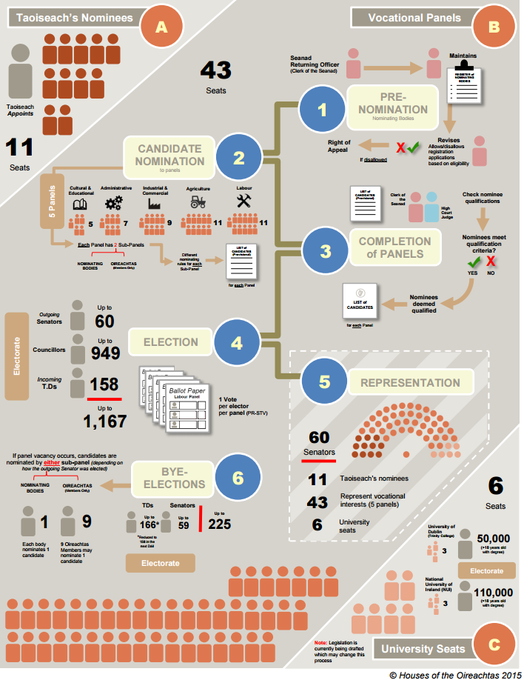
Seanad Éireann Electoral Process Infographic
The graphic illustrates how Seanad Éireann is elected, with a particular focus on the vocational panel elections, and highlights the Constitutional and legislative provisions governing the electoral process.
Seanad Éireann Electoral Process L&RS Note
How Seanad is elected Department of Environment and Local Government.
Links
Seanad nominating bodies thread on Politics.ie.
User:Jnestorius/Vocational Panels Historical list of bodies registered for the nominating bodies subpanel of the Vocational Panels electing senators to Seanad Éireann. by Wikipedia User Jnestorius.
Past Reforms and Present Policy: examining the Seanad Electoral Act, 1947 Elaine Byrne History Hub
Submission to 2003 Review
Seanad Nominting Bodies 2015 Register of Nominating Bodies Archive
Electoral Roll
Seanad General Election List of Candidates
Seanad Count
Councillors
David Norris:Private Members Motion on Seanad Reform - 11th March 2009
A special committee of Seanad Éireann was set up to look into the situation of the renditions at Shannon Airport. This was scuppered because local councillors down in County Clare put the squeeze on the Government parties and the committee was abolished. This shows a distortion of the power through local parish pump politics and that is the main reason I object to the motion.
Seanad Reform Timeline
| Dail 29 | Report on Seanad Reform | 2004 |
| Dail 30 | All-Party Seanad Reform Group | 01/09/2008 |
| Dail 30 | Seanad Reform: Motion | Joe O'Toole 11/03/2009 |
| Dail 30 | Seanad Reform: Motion | David Norris 20/01/2010 |
| Dail 30 | Seanad Reform: Motion | Joe O'Toole 03/11/2010 |
| Dail 31 | Seanad Reform: Motion | Katherine Zappone 15/06/2011 |
| Dail 31 | Seanad Electoral Reform Bill 2013 | John Crown 01/03/2013 |
| Dail 31 | Seanad, Bill 2013 | Senator Katherine Zappone; and Senator Feargal Quinn; and Senator Mary Ann O'Brien 09/05/2013 |
| Dail 31 | Seanad (No. 2) Bill 2013 [PMB] | Deputy Stephen S. Donnelly and Deputy Noel Grealish and Deputy Finian McGrath and Deputy Mattie McGrath and Deputy Shane Ross 28/05/2013 |
| Dail 31 | Abolishment bill | 2013-07-17 |
| Dail 31 | Referendum | Failed 04/10/2013 |
| Dail 31 | A Bill to Reform the Seanad | Senator Katherine Zappone 07/10/2013 |
| Dail 31 | Seanad Reform: Statements | 23/10/2013 |
| Dail 31 | Seanad Reform Bill 2014 | Deputy Micheál Martin 09/05/2013 |
| Dail 31 | Seanad Reform: Motion | Katherine Zappone 29/01/2014 |
| Dail 31 | Political Reform: Motion | David Norris 12/02/2014 |
| Dail 31 | 100 days | 21/02/2014 |
| Dail 31 | Seanad Reform: Motion SF/Adams | 16/10/2014 |
Enda Kenny's Seanad flip flop timeline
Other Reports
Fien Gael Abolish Seanad Campaign Informatoin Leaflet
Seanad Electoral Law Commission, 1959 Report. Not available online, re Nomination Boies process.
Creating a balance between political election and vocationalism
: the
recommendations of the 1959 Seanad Electoral Law Commission, or
a variant of these, could be implemented. This would entail division
of each of the five panels into two more sharply differentiated
subpanels. One of these would consist of candidates nominated by
members of the Oireachtas, the electorate to be constituted as at
present. The other would consist of candidates proposed by nominating bodies, the electorate to consist of representatives of
these bodies themselves
Oireachtas 2nd-Report-Seanad 1997
write more about
submission
nominating bodies
councillors influence/ councillors power david norris
need more information on how they discuss with councillors and expert bodies
Government Reforms
Major Reforms Planned for Seanad - Cummins July 24th, 2014
The reforms include:
The Seanad is to review the work of the North South Ministerial Council and the British - Irish Council. The relevant Minister will make statements to the Seanad after attending such meetings.
The Seanad is to review the work of the North South Implementation Bodies;
The Seanad is to continue with the work of its Public Consultation Committee - bringing the citizen closer to Parliament;
The Seanad will continue to invite high profile individuals to address the House to inform and advise on particular areas of expertise;
The Government is to outline its legislative priorities for the year ahead in the Seanad in the same manner as in the Dáil;
The Seanad may review reports of Oireachtas Committees and make recommendations to relevant Ministers;
The Seanad is to debate the European Commission’s annual work programme and review reports from Oireachtas Committees on EU policy proposals;
The Seanad Order of Business is to be re-scheduled to avoid clashes with Oireachtas Committee sittings. This will allow both the Seanad and the Committees to do their work more efficiently and uninterrupted by one another;
The existing system of Adjournment Debates is to be replaced by Commencement Debates which will take place before the daily Order of Business in the Seanad. This will allow Senators to raise issues with Ministers earlier in the day and represents a more effective use of the time of the House and Ministers
Reports of the Seanad Public Consultation Committee
Commencement Matters of Seanad Éireann
Maurice Cummins speech on Seanad Reform Working Group
british-peer-was-asked-for-advice-on-boosting-seanad-profile
Sources have confirmed that the plans involve making the Seanad available, for the first time, for interest and societal groups in areas such as education.Seanad Nomination Bodies
It's understood that an association of guidance counsellors are to become the first group to avail of the new initiative.
Government response to Private Members bill
Seanad Standing Orders
Modifications currently in effect to the 2011 Edition of Seanad Éireann Standing Orders
Standing Orders of the Seanad
Seanad sittings down 10% since referendum 28 July 2014 Reduced Seanad sittings is governments fault not Seanad
Seanad to introduce reforms to improve efficiency
Standing Orders: Motion section:seanad Kildarestreet.com search.
Seanad Committee on Procedure and Privileges Reports on changing og Seanad Standing orders.
Seventh report of the Committee on Procedure and Privileges on standing orders 70a, 71 & 119 and the adoption of new standing orders 113a & 137a (2014.) 16th July 2014
The proposed amendments make provision for-That the Report of the Committee on Procedure and Privileges on Standing Orders 70A, 71 and 119 and the adoption of New Standing Orders 113A and 137A be adopted, laid before the Seanad and printed. 2014-07-17
(i) Post-enactment reports by Ministers on the implementation of Acts and the consideration of such reports by Committees; and
(ii)Pre-legislation considerations by Committes of the draft heads of Bills and additional speaking arrangements at Second Stage where pre-legislative consideration has taken place.
Schedule
Establishment of Committees
Powers of Select Committees
Pre-legislative consideration
Procedure on Second Stage
Post Enactment consideration
Eighth report of Seanad Committee on Procedure and Privileges on standing orders 16, 19, 20, 29, 65, 119 and 123 / Seanad Committee on Procedure and Privileges (2014.) 15th December 2014
The proposed amendments make provision for-
(i) Replacement of adjournment matters by commencement matters to be taken at the start of sittings on Tuesday, Wednesdays and Thursdays;
(ii) Consequential deferral to a later time on those days of the Order of Business;
(iii) Changing the quorum requirements for a sitting at which commencements matters are being taken and for the Order of Business;
(iv) Enshrining current practice in relation to the nature of amendments to a motion at Second Stage of a bill;
(v) Simplifies procedures for disposal of amendments to a motion for second reading of a Government Bill;
(vi) Simplifies the question on a section of a bill at Committee Stage.
Schedule
Leader of the House
Quorum required
Procedure if no quorum at hour fixed for meetings
Matter for discussion at the commencement of sittings
Quorum of Committee of the whole Seanad
Procedure on Second Stage
New section, Disposal of amendments, Preamble and title.
"That the report of the Committee on Procedure and Privileges on Standing Orders 16, 19, 20, 29, 65, 119 and 123 be adopted, laid before the House and printed." motion 2014-12-17
http://www.irishexaminer.com/ireland/senators-got-leg-up-before-late-late-showdown-88499.html
http://oireachtasdebates.oireachtas.ie/debates%20authoring/debateswebpack.nsf/takes/seanad2013062700021?opendocument



